



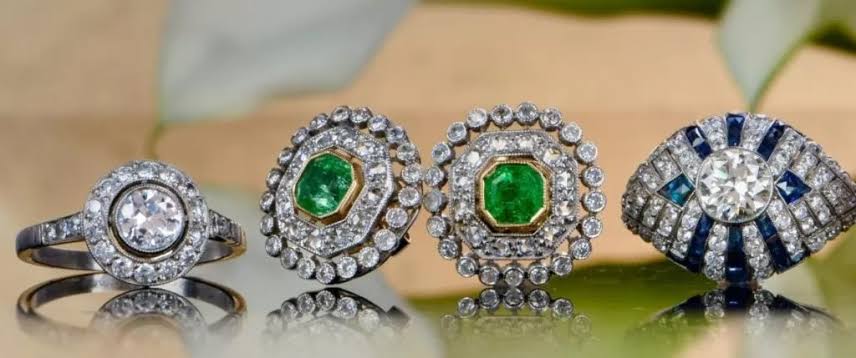
Few jewelry styles have maintained their appeal across a full century quite like those produced during the Art Deco period. Bold, geometric, and meticulously crafted, art deco estate rings have become among the most sought-after pieces in the vintage jewelry market — prized by collectors, chosen as engagement rings, and gifted as heirloom-quality tokens of lasting significance. Understanding what defines these pieces — their history, their visual hallmarks, and what separates an authentic example from a later reproduction — is the essential starting point for any serious buyer.
The Art Deco Era in Context
The Art Deco movement emerged in the 1920s and flourished through the 1930s, taking its name from the landmark 1925 Exposition Internationale des Arts Décoratifs et Industriels Modernes held in Paris. The period was shaped by a cultural embrace of modernity and elegance following the upheaval of the First World War. Jewelry from this era reflects a convergence of influences: the discovery of Tutankhamun’s tomb in 1922 introduced Egyptian motifs into Western design; the geometric precision of Cubism reshaped visual composition across the decorative arts; and advances in platinum craftsmanship allowed for settings of unprecedented delicacy and intricacy that earlier metalworking techniques could not achieve.
Defining Characteristics of the Style
Art Deco rings are immediately distinguishable by their structured, architectural quality. Where earlier Victorian and Edwardian pieces favored flowing, nature-inspired forms, Art Deco jewelry embraces symmetry, angular geometry, and deliberate precision. Hexagons, chevrons, stepped profiles, and sunburst patterns appear with remarkable consistency across the style, regardless of a piece’s origin or price point.
Color contrast is another defining hallmark. Designers of the era deliberately paired gemstones of opposing hues to striking visual effect — deep sapphires alongside diamonds, vivid emeralds set against polished onyx, or rubies flanked by white stones. Milgrain edging, a fine beaded border applied along the perimeter of a setting, is perhaps the most reliable single detail for identifying authentic Art Deco jewelry and appears across a wide range of makers and price categories.
Gemstones and Materials of the Period
Diamonds dominated Art Deco jewelry, with two cuts serving as the defining stone shapes of the era. The old European cut, a precursor to the modern round brilliant, appears frequently in center stone positions. The baguette cut — a narrow, rectangular, step-cut stone — became synonymous with the linear, graphic arrangements that characterize Art Deco settings and was used extensively as an accent stone to frame center gems within precisely ordered compositions. The emerald cut also gained considerable prominence during this period and remains closely associated with Art Deco aesthetics today.
Beyond diamonds, sapphires, rubies, emeralds, onyx, coral, and jade appeared regularly as accent stones or as fields of bold, saturated color. Platinum was the preferred metal for quality Art Deco pieces: its strength, white color, and exceptional workability made it ideal for the fine filigree, open lacework, and delicate hand-engraving that define the era’s finest craftsmanship.
Why These Rings Remain Highly Desirable
The sustained demand for Art Deco estate rings reflects more than nostalgia. These pieces offer something that contemporary fine jewelry rarely can: an established provenance, a visual identity that stands entirely apart from modern mass production, and a standard of handcraftsmanship that has largely disappeared from commercial jewelry manufacturing.
For engagement ring shoppers, Art Deco estate rings present a compelling alternative to new pieces. They are by definition unique, carry genuine historical narrative, and frequently represent exceptional value relative to newly manufactured jewelry at comparable price points. For collectors, they occupy a stable, historically grounded category with a consistent and well-documented record of market demand. The sustainability dimension is increasingly relevant as well — acquiring an estate ring requires no new mining, no new manufacturing, and carries no additional environmental cost.
What to Look for When Buying
Authenticity is the central concern with any estate purchase. Genuine Art Deco pieces should show consistent period construction: hand-engraving rather than machine-produced etching, platinum or period white gold rather than modern alloys, and stone cuts consistent with early twentieth-century technique. Minor wear is expected and is often preferable to heavy restoration, which can compromise both a piece’s character and its market value.
Provenance adds meaningful assurance — appraisals, prior ownership records, or documented estate origins all support a piece’s legitimacy. Purchasing from a recognized specialist rather than a generalist reseller significantly reduces the risk of acquiring a later reproduction. For any ring featuring a significant colored gemstone or a large center diamond, an independent gemological assessment is a sound investment before completing a purchase.
Acquiring a Piece That Will Last Another Century
Art Deco estate rings are not simply beautiful objects. They are tangible connections to one of the most deliberate and accomplished periods in design history — built with precision, made to endure, and recognized by the market as jewelry of genuinely lasting value. For collectors pursuing authenticity, couples seeking a ring with real character, or buyers in search of a gift that transcends the ordinary, this category offers something no contemporary piece can replicate.
Gesner Estate Jewelry specializes in authenticated antique and vintage rings sourced from significant private estates and collections. Browse their curated selection to discover Art Deco pieces that embody the artistry, precision, and enduring elegance of this remarkable era.
