



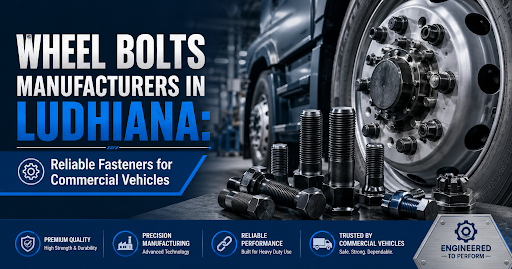
Wheel bolts are critical automotive fasteners used to secure vehicle wheels firmly to the hub or wheel assembly. In trucks, trailers, buses, agricultural vehicles and heavy machinery, these bolts must handle continuous vibration, high torque, changing road conditions and heavy operating loads.
Businesses searching for dependable wheel bolts manufacturers in Ludhiana usually require products with accurate threading, high tensile strength, correct head dimensions and consistent heat treatment. Since wheel bolts directly affect wheel retention and road safety, product quality should never be compromised.
What Is a Wheel Bolt?
A wheel bolt is a threaded fastener used to attach a wheel to the vehicle hub. Depending on the vehicle design, the wheel may be secured using wheel bolts, wheel studs with nuts, or a combination of related fastening components.
Wheel bolts are commonly used in:
- Trucks
- Trailers
- Buses
- Light commercial vehicles
- Passenger vehicles
- Agricultural tractors
- Construction equipment
- Mining vehicles
- Industrial transport machinery
The bolt must match the wheel hub, thread size, seating profile and tightening requirements of the specific vehicle.
Why Ludhiana Is Known for Wheel Bolt Manufacturing
Ludhiana is one of India’s major engineering and automotive component manufacturing centres. The city has a well-developed network of steel suppliers, forging units, machining facilities, heat-treatment plants and skilled labour.
Professional wheel bolts manufacturers in Ludhiana supply their products to:
- Automotive spare-parts dealers
- Commercial vehicle workshops
- Fleet operators
- Vehicle assembly units
- Tractor parts suppliers
- Exporters
- Industrial equipment manufacturers
- Replacement parts distributors
The manufacturing ecosystem in Ludhiana allows suppliers to produce both standard and customised wheel bolts for different vehicle models and operating applications.
Main Function of a Wheel Bolt
The primary purpose of a wheel bolt is to create a secure clamping force between the wheel and the hub.
A properly selected and tightened wheel bolt helps:
- Keep the wheel firmly attached
- Maintain correct wheel positioning
- Distribute clamping pressure evenly
- Reduce movement between the wheel and hub
- Support safe braking and steering
- Prevent loosening caused by vibration
- Maintain vehicle stability under load
Wheel bolts do not work independently. Their performance also depends on the wheel condition, hub surface, thread quality, tightening sequence and correct torque.
Types of Wheel Bolts
Wheel bolts are manufactured in different designs according to vehicle and wheel requirements.
Standard Wheel Bolts
These are produced in commonly used sizes and thread patterns for standard vehicle applications.
Flange Wheel Bolts
Flange wheel bolts have a wider bearing surface under the head. This helps distribute clamping pressure over a larger area.
Conical Seat Wheel Bolts
Conical seat bolts have a tapered seating surface that fits into a matching tapered wheel hole. They help centre the wheel during installation.
Ball Seat Wheel Bolts
Ball or radius seat bolts have a curved seating profile. These are used where the wheel design requires a rounded contact surface.
Flat Seat Wheel Bolts
Flat seat bolts use a washer or flat bearing surface to secure the wheel.
Serrated Wheel Bolts
Serrations may be added to selected designs to reduce unwanted rotation or improve fitting in specific assemblies.
Custom Wheel Bolts
Custom bolts are produced according to vehicle drawings, old samples or technical specifications. Buyers may specify:
- Bolt diameter
- Thread pitch
- Overall length
- Thread length
- Head size
- Seating profile
- Material grade
- Strength class
- Surface finish
- Branding or head marking
Materials Used in Wheel Bolt Manufacturing
Wheel bolts must resist stretching, bending, fatigue and thread damage. Manufacturers therefore use materials selected for high strength and durability.
Common options may include:
- Carbon steel
- Medium-carbon steel
- Alloy steel
- Automotive-grade steel
- Buyer-specified steel grades
The correct material depends on the vehicle weight, wheel design, operating load and required strength class.
Heavy commercial vehicles generally require wheel bolts with greater strength than light-duty applications. Reliable manufacturers select the steel grade according to the required mechanical properties rather than using one material for every product.
Importance of Heat Treatment
Heat treatment is one of the most important stages in wheel bolt production. It helps achieve the required hardness, tensile strength and fatigue resistance.
An under-treated bolt may stretch or deform under tightening pressure. An excessively hard bolt may become brittle and fail suddenly.
A controlled heat-treatment process may include:
- Hardening
- Quenching
- Tempering
- Stress relieving
- Batch-level hardness testing
The process must be matched to the steel grade and required performance standard.
Manufacturing Process of Wheel Bolts
The exact process depends on the bolt size and design, but a typical manufacturing sequence includes the following stages.
Raw Material Selection
Steel rods or wire of the required diameter and grade are selected.
Cutting
The material is cut into individual blanks based on the required bolt length.
Head Forming
The bolt head is formed through cold forging, hot forging or machining.
Trimming and Shaping
The head and seating surface are shaped to the required profile.
Thread Rolling
Threads are generally rolled rather than cut for many automotive fasteners. Rolled threads can provide improved strength, smoother surfaces and better dimensional consistency.
Heat Treatment
The bolt is heat treated to achieve the required mechanical properties.
Surface Coating
Protective finishes may be applied to improve corrosion resistance and appearance.
Inspection
Finished bolts are checked for dimensions, thread accuracy, hardness, head profile, straightness and surface condition.
Surface Finishes for Wheel Bolts
Wheel bolts are exposed to water, mud, dust, road salt and changing temperatures. Surface treatment helps reduce corrosion and improve product life.
Common finishes may include:
- Black finish
- Zinc plating
- Yellow zinc coating
- Phosphate coating
- Geomet-type coating
- Dacromet-type coating
- Nickel or chromium-based decorative finishes
- Customer-specified protective treatments
The suitable finish depends on the operating environment, appearance requirements and corrosion-resistance expectations.
Qualities of a Reliable Wheel Bolt
Before purchasing wheel bolts, buyers should check the following characteristics.
Accurate Thread Size
The thread diameter and pitch must match the vehicle hub or nut exactly. Incorrect threads can damage the hub and create unsafe installation.
Correct Length
A bolt that is too short may not provide enough thread engagement. A bolt that is too long may interfere with internal components.
Proper Seating Profile
Conical, ball and flat seats are not interchangeable. The bolt seat must match the wheel design.
High Tensile Strength
The bolt must handle tightening force, vehicle load and road vibration without stretching or breaking.
Strong Head Formation
The head should be properly shaped so that tools can apply torque without slipping or damaging the bolt.
Uniform Heat Treatment
Inconsistent hardness can cause some bolts in the same batch to perform differently.
Corrosion Resistance
A suitable surface finish helps protect the bolt during storage and operation.
How to Choose Wheel Bolts Manufacturers in Ludhiana
Choosing the right manufacturer involves more than selecting the lowest quotation.
Check Manufacturing Experience
A supplier with experience in automotive fasteners is more likely to understand thread standards, strength requirements and vehicle-specific applications.
Review Product Range
Confirm whether the manufacturer produces the required sizes, lengths, seating profiles and thread pitches.
Ask About Customisation
The manufacturer should be able to develop bolts from drawings, samples or vehicle details when standard parts are unavailable.
Verify Material and Strength
Ask for information about the steel grade, heat treatment and strength class.
Understand the Inspection Process
Reliable manufacturers should inspect:
- Thread pitch
- Bolt diameter
- Overall length
- Head size
- Seat profile
- Hardness
- Surface finish
- Straightness
Evaluate Production Capacity
Wholesalers, exporters and vehicle manufacturers should confirm whether the supplier can maintain regular volume without affecting consistency.
Check Packaging
Wheel bolt threads and finishes can be damaged during transport. Proper packaging is important for domestic and export shipments.
Confirm Delivery Reliability
Consistent delivery schedules help workshops, distributors and fleet operators maintain inventory and avoid repair delays.
Common Causes of Wheel Bolt Failure
Wheel bolts may fail because of manufacturing defects, incorrect fitting or poor maintenance.
Common causes include:
- Incorrect thread size
- Wrong seating profile
- Low-quality steel
- Poor heat treatment
- Excessive tightening torque
- Insufficient tightening
- Uneven tightening sequence
- Corroded threads
- Damaged wheel holes
- Dirty hub surfaces
- Reusing stretched bolts
- Overloaded vehicles
- Loose wheel nuts or bolts
- Incorrect bolt length
Failure may result in wheel movement, damaged studs, enlarged wheel holes or, in serious cases, wheel separation.
Signs of a Damaged or Loose Wheel Bolt
Vehicle owners and technicians should check for signs such as:
- Repeated wheel loosening
- Clicking or knocking sounds
- Vibration near the wheel
- Damaged bolt heads
- Rust around the wheel holes
- Broken or stretched threads
- Uneven wheel seating
- Difficulty tightening the bolt
- Visible movement between the wheel and hub
These symptoms should not be ignored. The wheel, hub, bolts and related components should be inspected immediately.
Importance of Correct Torque
Wheel bolts must be tightened according to the vehicle manufacturer’s recommended torque.
Under-tightening may allow the wheel to move. Over-tightening may stretch the bolt, damage threads or distort the wheel.
Best practices generally include:
- Cleaning the bolt and hub threads
- Checking the seating surfaces
- Using the correct socket
- Tightening in the recommended sequence
- Applying the specified torque
- Rechecking torque after wheel installation when required
- Avoiding uncontrolled impact-wrench tightening
Correct torque helps create balanced clamping pressure across the wheel.
Wheel Bolts and Wheel Studs: Key Difference
Wheel bolts screw directly into threaded holes in the hub. Wheel studs are permanently or semi-permanently installed in the hub, and the wheel is secured using wheel nuts.
Both systems perform the same basic function, but their installation methods differ.
When ordering replacement parts, buyers should confirm whether the vehicle requires:
- Wheel bolts
- Wheel studs
- Wheel nuts
- Hub bolts
- Complete fastening kits
Using the wrong component can damage the wheel hub and create unsafe operating conditions.
Custom Wheel Bolt Requirements
Custom manufacturing may be necessary for older vehicles, imported equipment, modified wheels or specialised industrial machines.
The manufacturer may require the following details:
- Vehicle make and model
- Bolt diameter
- Thread pitch
- Overall length
- Threaded length
- Head dimensions
- Seat type
- Material grade
- Strength class
- Surface coating
- Quantity required
Providing an old sample or technical drawing can reduce the possibility of dimensional errors.
Benefits of Buying Directly from a Manufacturer
Sourcing directly from experienced wheel bolts manufacturers in Ludhiana (Benz Auto Corporation) can provide several advantages:
- Competitive bulk pricing
- Standard and custom sizes
- Better control over material grade
- Consistent threading and dimensions
- Direct technical coordination
- Reliable repeat orders
- Private-label packaging
- Custom head markings
- Domestic and export supply
- Batch-level quality inspection
Direct sourcing is useful for automotive distributors, fleet operators, suspension workshops, vehicle manufacturers and international buyers.
Wheel Bolt Maintenance Tips
Regular inspection can help prevent wheel fastening problems.
Important maintenance practices include:
- Inspecting bolts during tyre replacement
- Replacing bolts with damaged threads
- Checking for corrosion
- Cleaning wheel and hub contact surfaces
- Using the correct torque setting
- Avoiding mixed bolt types on one wheel
- Matching the bolt seat to the wheel
- Replacing stretched or deformed bolts
- Inspecting wheel holes for wear
- Rechecking newly fitted wheels as recommended
Wheel bolts should be treated as safety components rather than ordinary hardware.
Conclusion
Wheel bolts play a direct role in securing vehicle wheels and maintaining safe road performance. Their dimensions, material quality, thread accuracy, seating profile, heat treatment and surface finish must match the intended application.
Choosing reliable wheel bolts manufacturers in Ludhiana helps businesses source strong and precisely manufactured fasteners for trucks, trailers, buses, tractors and industrial vehicles.
Buyers should select wheel bolts based on technical compatibility and quality standards rather than price alone. A correctly manufactured and properly installed wheel bolt helps ensure secure wheel mounting, dependable vehicle performance and improved road safety.
