



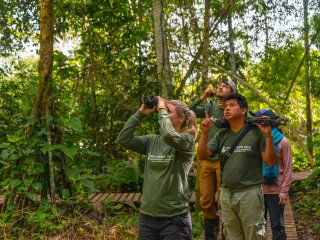
The Chuncho macaw clay lick full day, locally known as Collpa Chuncho, stands as one of the Amazon rainforest’s most extraordinary natural phenomena. A full-day excursion to this remarkable site offers travelers the opportunity to witness hundreds of brilliantly colored macaws and parrots gathering on a single clay wall in what many consider the greatest wildlife spectacle in South America. While multi-day tours provide the most reliable access to this remote location, dedicated full-day visits allow time-conscious travelers to experience this bucket-list encounter without extended jungle stays, though the journey demands commitment and early rising to succeed.
Understanding the Chuncho Clay Lick Phenomenon
Chuncho represents the largest known macaw clay lick on Earth, attracting gatherings that can include 500 to 1,000 individual birds on peak mornings. This vertical clay bank along the Tambopata River contains essential minerals that macaws and other parrots require for their survival and health. The birds consume the mineral-rich clay to neutralize toxins present in their diet of unripe fruits and seeds, essentially using the natural formation as a communal pharmacy where entire flocks gather for their daily supplement.
What distinguishes Chuncho from dozens of other clay licks scattered throughout the Amazon is its exceptional size and the sheer diversity of species it attracts. Blue-and-yellow macaws, scarlet macaws, red-and-green macaws, chestnut-fronted macaws, and various smaller parrot species create a living rainbow when they descend simultaneously to feed. The spectacle combines overwhelming visual beauty with an extraordinary cacophony of calls, squawks, and wing beats that assault the senses in the most glorious way imaginable.
The clay wall itself measures approximately 50 meters in length and towers several meters above the river, providing ample feeding space for massive flocks. The exposed clay contains specific minerals including sodium and calcium that are scarce in the macaws’ natural diet. Scientists believe the clay also helps bind toxins in the digestive system, allowing the birds to safely consume foods that would otherwise sicken them. This geological formation has likely served as a gathering point for macaws for thousands of years, creating a natural heritage site of immeasurable ecological value.
The Full-Day Journey Begins Before Dawn
A successful full-day visit to Chuncho macaw clay lick requires extraordinary commitment, beginning with departures from Puerto Maldonado or nearby lodges well before sunrise. Most tours leave between 3:00 and 4:00 AM, allowing the four to five hour upstream journey to conclude before peak activity hours at the clay lick. The pre-dawn boat ride through darkness adds adventurous atmosphere to the experience, with the forest gradually awakening around you as the sky lightens.
The extended river journey serves multiple purposes beyond simple transportation. The Tambopata River itself teems with wildlife, and even during the early morning darkness, caimans’ eyes reflect in spotlight beams while nocturnal birds call from overhanging vegetation. As dawn breaks, the riverbanks come alive with activity—capybaras emerge to graze, herons begin fishing in the shallows, and various monkey species start their morning foraging. Your guide will point out wildlife throughout the journey, ensuring travel time never feels wasted.
The journey upstream also allows gradual transition from the relative civilization near Puerto Maldonado into increasingly pristine wilderness. Human settlements disappear, replaced by unbroken rainforest stretching to distant horizons. The river transforms as well, with clearer water and more dramatic scenery. This progressive immersion into wild nature prepares you mentally and emotionally for the extraordinary encounter awaiting at Chuncho.
Arrival and the Building Anticipation
Upon reaching the clay lick area, typically around 6:00 to 7:00 AM depending on river conditions, your guide will navigate to designated observation points. These carefully positioned locations allow unobstructed viewing while maintaining sufficient distance to avoid disturbing the birds’ natural behavior. Guests settle into camouflaged blinds or observation areas, arranging cameras and binoculars while the guide explains what to expect during the coming hours.
The anticipation builds palpably as the forest awakens fully around you. Bird calls echo from every direction, creating a dawn chorus of incredible complexity. Small parrots and parakeets arrive first, serving as scouts that assess the area for potential threats. These smaller species test the clay lick’s safety, feeding briefly while remaining hyper-alert for predators. Their presence and behavior signal larger species that conditions may be favorable for feeding.
The macaw gathering unfolds gradually, each phase adding to the mounting excitement. Small groups of macaws begin circling overhead, their distinctive calls carrying across the river valley. More birds join the aerial ballet, creating swirling flocks that grow steadily larger. The colorful bodies against blue sky create spectacular photography opportunities even before the main event begins. This staging behavior can continue for 30 minutes to over an hour as the flock waits for optimal safety conditions.
The Moment of Glory: Mass Landing
When the birds finally commit to landing, the transformation is instantaneous and breathtaking. In a coordinated movement that seems almost choreographed, hundreds of macaws descend simultaneously upon the clay wall. The sound alone is extraordinary—a thunderous rush of wings accompanied by excited vocalizations as birds jostle for feeding positions. The previously earth-toned clay face becomes completely covered with brilliant color, creating a living mosaic that defies adequate description.
Individual birds use their powerful curved beaks to scrape clay from the vertical surface, often hanging at seemingly impossible angles. Mated pairs feed side by side, their lifelong bonds evident in their proximity and occasional mutual preening between bites. Juveniles, identified by slightly duller plumage and uncertain movements, learn feeding techniques by watching their parents. The social dynamics of the flock create constant movement and interaction, ensuring endless photographic opportunities and behavioral observations.
The diversity of species present adds layers of interest to the spectacle. Blue-and-yellow macaws, with their vibrant azure and gold plumage, often dominate numerically. Scarlet macaws provide stunning red accents, while red-and-green macaws add burgundy and emerald tones to the palette. Smaller species including various Amazon parrots, parakeets, and occasionally even toucans join the feast, each occupying its preferred position on the clay wall according to social hierarchies and species-specific preferences.
Duration and Dynamics of the Feeding Session
The feeding session typically continues for two to four hours depending on conditions, though the exact duration remains unpredictable. Weather plays a crucial role—macaws strongly prefer sunny mornings when visibility is excellent and they can easily spot approaching predators. Overcast skies or light rain may delay activity or reduce attendance significantly. This unpredictability is part of working with wild animals in their natural habitat, adding both risk and reward to the full-day adventure.
Any perceived threat can trigger sudden mass departures. A harpy eagle passing overhead, unusual sounds, or even shadows from clouds can cause the entire flock to explode upward in a thunderous evacuation. These sudden dispersals, while temporarily interrupting the spectacle, add dramatic tension to the viewing experience. The flock typically circles overhead for several minutes, calling constantly, before individuals begin cautiously returning to the clay face. These evacuation-and-return cycles can occur multiple times during a morning, each providing different perspectives and photographic opportunities.
As the morning progresses and birds satisfy their mineral requirements, the flock gradually disperses back into the forest. Individuals and pairs depart in small groups, flying off toward feeding areas where they’ll spend the remainder of the day consuming fruits. The departure is less coordinated than the arrival, occurring over 30 to 60 minutes as different birds complete their clay consumption. Eventually only a few stragglers remain, and the clay lick returns to quiet emptiness until the following morning’s ritual repeats.
Photography Opportunities and Challenges
The Chuncho clay lick represents a photographer’s dream destination, offering world-class opportunities to capture vibrant wildlife in dramatic natural settings. However, successfully photographing the spectacle requires understanding both the opportunities and challenges inherent in the location and conditions.
Telephoto lenses are essential for quality images, with focal lengths between 400mm and 600mm providing ideal reach for filling the frame with individual birds or small groups. Image stabilization becomes crucial given the extended handheld shooting sessions and the distance involved. Many photographers also bring wide-angle lenses to capture the full scope of the clay wall covered with hundreds of birds, creating images that convey the spectacle’s overwhelming scale.
The technical challenges begin with low light during early morning hours when activity peaks. Macaws are surprisingly fast-moving despite their size, requiring shutter speeds of 1/1000 second or faster to freeze action. This necessity forces high ISO settings, making cameras with good high-ISO performance valuable. As the sun rises and illuminates the scene, dynamic range becomes the primary challenge—bright clay and shadowed forest create exposure extremes that can exceed most cameras’ capabilities.
Beyond technical considerations, patience and persistence define successful clay lick photography. The birds’ behavior is inherently unpredictable, with the best moments occurring unexpectedly. Remaining alert and ready throughout the morning session ensures you capture those fleeting perfect compositions—a macaw in mid-flight against blue sky, two birds engaged in social interaction, or the magical moment when hundreds land simultaneously. Professional photographers often visit multiple times to capture their ideal images, illustrating that even a full day provides limited opportunities for perfection.
The Return Journey and Reflection
After the macaws disperse and the feeding session concludes, the return journey downstream commences. Traveling with the current moves significantly faster than the upstream journey, typically requiring three to four hours compared to the earlier four to five. The boat ride provides time for reflection on the extraordinary spectacle witnessed, reviewing photographs, and discussing observations with your guide and fellow travelers.
The downstream journey often yields different wildlife sightings than the morning trip. Species that were inactive during the pre-dawn darkness now forage actively along the riverbanks. Your guide may make occasional stops at interesting locations or when significant wildlife appears, ensuring the return trip contributes to rather than merely concluding the adventure. Many travelers report feeling profoundly moved by the Chuncho experience, with the return journey allowing time to process emotions and integrate the experience into memory.
Arrival back in Puerto Maldonado typically occurs in early to mid-afternoon, concluding an exhausting but exhilarating full-day adventure. The physical demands of the early start, extended boat travel, and hours of concentrated observation leave most participants tired but deeply satisfied. The images captured and memories created provide lasting reminders of a truly exceptional natural phenomenon that few people ever witness.
Practical Considerations for Success
Successfully experiencing Chuncho macaw clay lick in a full-day format requires realistic understanding of the challenges and limitations. The extreme distance means most of your day is consumed by travel rather than observation, and the tight schedule allows no flexibility if conditions prove unfavorable. Full-day trips essentially provide one opportunity to witness the spectacle—if weather is poor or birds are uncooperative that morning, you have no second chance without booking another trip.
The physical demands should not be underestimated. Waking at 2:00 or 3:00 AM after limited sleep, spending eight to ten hours in a boat, and maintaining concentration during the viewing session requires stamina and resilience. Comfortable clothing, adequate sun protection, motion sickness medication if needed, and substantial food and water supplies all contribute to successful full-day expeditions. The remote location means no facilities exist at the clay lick itself—you must bring everything required for comfort and sustenance.
Conclusion
A Chuncho macaw clay lick full day represents one of the most spectacular yet demanding wildlife experiences available in the Amazon rainforest. The commitment required—extreme early rising, extensive boat travel, and physical endurance—is rewarded with the privilege of witnessing nature’s most colorful daily ritual. Hundreds of wild macaws descending on a clay wall in an explosion of color and sound creates sensory experiences and emotional responses that photographs alone cannot capture. This is nature at its most raw and magnificent, operating according to ancient patterns unchanged by human civilization.
While multi-day trips to Chuncho provide more reliability and flexibility, determined travelers can experience this bucket-list phenomenon in a single intensive day. The gamble of weather and bird behavior adds risk but also heightens the reward when conditions align favorably. For those who successfully witness the full spectacle, the Chuncho macaw clay lick becomes a transformative experience that deepens appreciation for biodiversity, wilderness, and the urgent importance of conservation efforts protecting these irreplaceable natural treasures for future generations.
