



Few names associated with the underground cybercrime economy have generated as much curiosity, confusion, and misinformation as BriansClub.
Often referred to online as bclub, briansclub, or simply brians club, the marketplace became well known for offering stolen payment-card details for sale. Yet the stories that grew around its name can distract from the larger cybersecurity issues exposed by the operation. BriansClub provided researchers with insight into how payment data is stolen and traded, how underground marketplaces function, and how criminal groups can turn compromised information into a profitable business.
The available evidence is significant on its own. Analysis of data leaked from BriansClub showed that more than 19 million unique card numbers had been listed on the marketplace between 2015 and 2019. During the same period examined by researchers, the platform generated nearly $104 million in gross revenue.
The 2019 compromise of BriansClub provided researchers with an unusual opportunity to study that underground economy from the inside. More than 26 million stolen payment-card records were extracted from the marketplace and subsequently shared with security researchers and financial institutions.
So, what is fact, what is myth, and what can cybersecurity professionals actually learn from the BriansClub phenomenon?
What Was BriansClub?
At its core, BriansClub was an illicit marketplace associated with stolen and leaked payment-card information.
Rather than being a conventional company or legitimate online service, it operated as part of the criminal underground economy. Its inventory consisted of payment-card data obtained through various forms of cybercrime and then offered to other criminals.
The marketplace also deliberately borrowed the identity of cybersecurity journalist Brian Krebs. Reporting from KrebsOnSecurity documented that the operation used his name, photographs, and reputation in its branding even though Krebs was not involved in operating the marketplace.
That detail created one of the earliest and most persistent misconceptions surrounding the name.
Myth: “BriansClub Was Brian Krebs’ Club”
Fact: It was not.
The name was effectively an impersonation tactic. The marketplace used Krebs’s identity as part of its branding, creating an association with a well-known security researcher who had spent years reporting on cybercrime.
This is an important lesson in itself. Criminal operations can deliberately manufacture recognizable identities to attract attention, create credibility within underground communities, or simply antagonize researchers and journalists.
A familiar name does not establish legitimate ownership, affiliation, or endorsement.
Myth 1: The 2019 BriansClub Incident Was a Law-Enforcement Seizure
One of the most common misunderstandings is that authorities simply seized BriansClub and its database.
The documented event was different.
In October 2019, someone compromised BriansClub and extracted more than 26 million stolen credit and debit card records. The information was subsequently provided to KrebsOnSecurity and shared with parties working to combat payment-card fraud.
That distinction matters.
A cyberattack against a criminal marketplace is not automatically equivalent to a law-enforcement seizure.
The 2019 incident is better understood as a breach of an underground criminal service. Contemporary reporting also contained speculation that a competitor may have been responsible, but that interpretation should not be confused with an established legal finding.
Why This Distinction Matters
Cybersecurity reporting frequently uses words such as:
- hacked
- seized
- dismantled
- shut down
- exposed
- infiltrated
These terms describe very different events.
For researchers, journalists, and ordinary readers, confusing them can produce a completely inaccurate understanding of what actually happened.
The BriansClub case demonstrates why the source, date, mechanism, and evidence behind an incident matter more than dramatic headlines.
Myth 2: The 26 Million Records Were All Active Cards
The figure of more than 26 million records is frequently repeated without sufficient context.
The 2019 breach exposed more than 26 million payment-card records that had been stored by BriansClub. Those records represented stolen data collected over several years.
That does not mean that 26 million consumers simultaneously had active, usable cards.
In fact, the subsequent NYU analysis provides an even more revealing picture.
Researchers found that BriansClub listed more than 19 million unique card numbers for sale between 2015 and 2019. Yet approximately 60% of the listed accounts did not find buyers.
That is a crucial cybersecurity insight.
Stolen Data Is Not the Same as Valuable Data
A compromised record can have little or no value to a criminal marketplace.
Its usefulness may depend on factors such as:
- whether the account remains active
- how recently the data was obtained
- what type of payment information was stolen
- whether fraud-prevention controls are likely to detect misuse
- whether the data is already known to financial institutions
- whether other criminals consider the information useful
This means the size of a breach alone does not tell us its real-world impact.
A database containing millions of records can be enormous while containing a much smaller number of immediately exploitable accounts.
Myth 3: BriansClub Was Just a Website Selling Credit Cards
That description is technically incomplete.
The NYU research is valuable because it showed that BriansClub functioned as an organized marketplace with recognizable economic characteristics.
Researchers analyzed four years of transactional information and found close to $104 million in gross revenue and approximately $24 million in estimated profit during the period studied.
The data also revealed a significant difference between supply and demand.
Approximately 97% of the marketplace’s inventory consisted of stolen magnetic-stripe data, yet customers purchased only around 40% of that inventory. By comparison, approximately 83% of card-not-present inventory was sold.
The important point isn’t how criminals conducted transactions. It is what this tells cybersecurity professionals about the underground economy.
Cybercrime Has Supply-and-Demand Dynamics
Criminal marketplaces are still markets.
They have:
- suppliers
- customers
- inventory
- pricing
- competition
- quality differences
- refunds and disputes
- changing demand
- economic incentives
That doesn’t make them legitimate businesses. It means that conventional economic analysis can help explain why certain forms of stolen information become more valuable than others.
The BriansClub research provided unusually concrete evidence of this phenomenon.
Myth 4: EMV Chips Made Payment-Card Theft Impossible
EMV chips significantly changed the economics of counterfeit card fraud, but they did not eliminate payment-card theft.
NYU researchers found that during the final two years covered by their leaked dataset, 85% of stolen magnetic-stripe data originated from cards that had EMV chips. The vulnerability persisted because chip-enabled cards could still be used through magnetic-stripe transactions in some circumstances.
This illustrates a broader security principle:
A security technology can reduce one attack path without eliminating every attack path.
The move toward chip-enabled cards was important, but payment security depends on the entire transaction ecosystem—not simply on whether a physical card contains a chip.
That lesson extends well beyond banking.
Myth 5: More Stolen Records Automatically Means More Criminal Profit
The BriansClub data challenges this assumption.
Researchers found that approximately 60% of the more than 19 million unique accounts listed did not find buyers.
In other words, enormous inventory did not translate directly into enormous realized demand.
This distinction is useful when evaluating claims about cybercrime.
There are at least three different quantities that should not be casually combined:
- Records exposed
- Records offered for sale
- Records actually purchased or monetized
They measure different stages of the criminal ecosystem.
Cybersecurity reporting becomes much more meaningful when these categories remain separate.
The BriansClub Name Also Demonstrates the Power of Impersonation
The use of Brian Krebs’s identity was not merely a strange branding choice.
It illustrates a recurring tactic in online criminal ecosystems: borrowing recognizable identities.
Criminal operators may impersonate:
- security researchers
- journalists
- companies
- government agencies
- technology brands
- financial institutions
- other criminals
The purpose can vary, but the underlying lesson is consistent: identity is not proof of authenticity.
This is particularly relevant when researching dark-web claims.
A site may claim to be affiliated with a famous person, organization, or established criminal group. That claim should be treated as an assertion requiring independent verification—not as evidence.
What the BriansClub Investigation Taught Cybersecurity Researchers
Perhaps the most important legacy of BriansClub isn’t the marketplace itself.
It is what researchers learned after obtaining real marketplace data.
The NYU study provided an unusually detailed view of an underground payment-card market, including its inventory, customers, revenue, and purchasing patterns.
That type of evidence is considerably more valuable than speculation based solely on advertisements or forum posts.
Lesson 1: Follow the Data
Cybersecurity investigations should distinguish between:
- rumors
- claims made by criminals
- media reports
- technical evidence
- independently analyzed datasets
BriansClub became especially valuable to researchers because the leaked information allowed them to move beyond anecdotal observations.
Lesson 2: Measure Behavior, Not Just Claims
A criminal marketplace can claim to have enormous inventory.
That does not establish that the inventory is active, desirable, authentic, or profitable.
Transactional data provided researchers with a way to examine what customers actually purchased.
That distinction between advertised capability and observed behavior is useful across cybersecurity investigations.
Lesson 3: Security Weaknesses Can Shift Rather Than Disappear
As payment technology improved, criminals did not simply stop looking for opportunities.
Instead, the economic incentives shifted.
The NYU findings showed that card-not-present information represented a relatively scarce and highly demanded category within the marketplace.
This is a recurring cybersecurity pattern: when one attack path becomes harder, attackers may search for another path offering a better return.
Security therefore has to evolve continuously.
What Consumers Can Learn From the BriansClub Case
Consumers don’t need to understand underground marketplaces to benefit from the lessons they expose.
The practical takeaway is that payment security is a shared responsibility involving consumers, merchants, banks, payment networks, and technology providers.
Useful habits include:
- Enable transaction alerts from your bank.
- Review statements regularly rather than waiting for a monthly surprise.
- Report unfamiliar transactions immediately.
- Use unique, strong passwords for financial accounts.
- Enable multi-factor authentication where available.
- Be cautious with unsolicited messages requesting payment information.
- Keep devices and browsers updated.
- Avoid entering financial credentials into unfamiliar websites.
Most importantly, don’t assume that having a modern payment card makes fraud impossible.
The BriansClub research showed that security technologies can reduce risk while leaving other weaknesses intact.
What Researchers Should Learn From the BriansClub Phenomenon
For cybersecurity students, journalists, threat researchers, and investigators, the case offers a particularly useful methodological lesson.
Dark-web research should prioritize evidence over spectacle.
That means:
Establish the Source
Ask where the information came from and whether the original evidence is available.
Establish the Timeline
A claim from 2019 should not automatically be presented as a description of the current threat landscape.
Separate Evidence From Interpretation
A database may demonstrate that records existed. It does not automatically prove every claim made about their origin, subsequent use, or financial impact.
Corroborate Important Claims
Where possible, compare technical evidence with reputable reporting, academic research, court records, security-company analysis, and statements from affected organizations.
Protect Sensitive Information
Researchers should avoid unnecessarily reproducing stolen credentials, payment information, personal data, or other material that could harm victims.
The objective of responsible cybersecurity research is to increase understanding without creating another avenue for abuse.
The Bigger Cybersecurity Picture
The BriansClub phenomenon matters because it exposed something larger than one criminal marketplace.
It demonstrated how cybercrime can develop into an ecosystem with specialized suppliers, marketplaces, customers, economic incentives, and supporting infrastructure.
It also showed why cybersecurity cannot be reduced to a single technology.
EMV chips matter. Fraud detection matters. Merchant security matters. Account monitoring matters. Threat intelligence matters. Incident response matters.
Each addresses a different part of the problem.
The BriansClub case also highlights the value of collaboration. Information obtained from the compromised marketplace was shared with researchers and financial institutions, enabling analysis that would have been difficult from public observations alone.
That collaborative model—researchers, journalists, financial institutions, security teams, and law enforcement sharing appropriate information—is an important component of modern cybercrime defense.
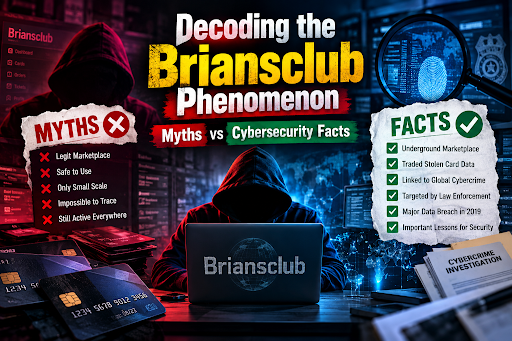
BriansClub Myths vs Facts The Essential Takeaways
The BriansClub story becomes much clearer when the mythology is stripped away.
Myth: BriansClub was operated by Brian Krebs.
Fact: The marketplace used Krebs’s identity and likeness without being operated by him.
Myth: The 2019 event was simply a government seizure.
Fact: The documented incident was a compromise in which more than 26 million stolen payment-card records were extracted and subsequently shared with security stakeholders.
Myth: Every exposed record represents an active, valuable account.
Fact: NYU researchers found that around 60% of more than 19 million listed accounts did not find buyers.
Myth: EMV chips eliminated payment-card theft.
Fact: The research showed that stolen magnetic-stripe data continued to exist even for cards equipped with EMV chips.
Myth: A huge inventory automatically means huge demand.
Fact: The marketplace contained substantial inventory that customers did not purchase.
Final Thoughts
The fascination surrounding bclub, briansclub, and brians club is understandable. The marketplace combined cybercrime, stolen financial data, anonymity, impersonation, and an unusually large 2019 data exposure.
But the most valuable story isn’t the mythology.
It’s the evidence.
The BriansClub investigation gave researchers a rare opportunity to examine an underground marketplace using real transactional data. The findings revealed an organized criminal economy, substantial revenue, uneven demand, persistent weaknesses in payment systems, and a clear relationship between security improvements and changes in criminal behavior.
For cybersecurity professionals, the lasting lesson is straightforward: don’t judge a cyber threat by its reputation, its branding, or the size of a headline. Examine the evidence, understand the underlying economics, separate exposure from actual impact, and keep the analysis grounded in verifiable facts.
That approach is useful far beyond BriansClub. It is one of the foundations of responsible cybersecurity research.
