



The decision to get first aid certified has become far easier to act on in recent years, and much of that change comes down to format. An online first aid course removes the scheduling barriers, travel requirements, and fixed attendance windows that have historically prevented many people from completing their training. For working adults, parents, healthcare workers with rotating shifts, and employers certifying multiple staff members, the online format is not a compromise on quality — it is a better fit for how people actually live and work. Understanding what these courses involve and what to expect makes the decision to enroll a straightforward one.
Addressing the Skepticism Around Online First Aid Training
The most common reservation about online first aid training is understandable: can someone genuinely learn life-saving skills without being in a classroom? The answer depends almost entirely on how the course is designed.
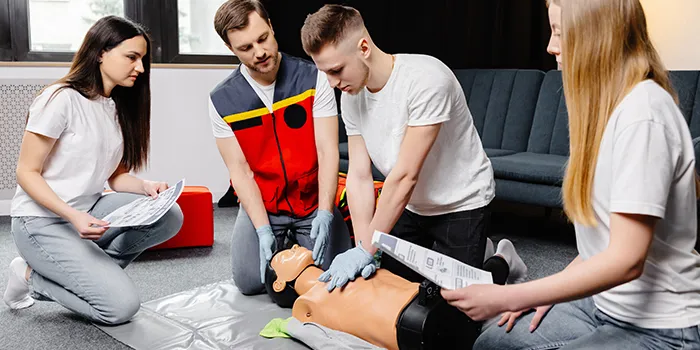
Reputable online programs do not attempt to replace hands-on practice with video content alone. The theoretical component — understanding how the body responds to injury, recognizing the signs of a medical emergency, and learning the correct sequence of interventions — is entirely suited to self-paced digital learning. Skills that require physical practice, such as compression depth and rescue breathing technique, are addressed through blended learning formats that pair online coursework with a short, focused in-person skills session. This structure is recognized and accepted by regulatory bodies and employers across Canada and internationally.
How Online First Aid Courses Are Structured
Most quality online first aid programs are organized into clearly defined modules covering distinct emergency scenarios. Learners progress through video instruction, illustrated content, and embedded knowledge checks at their own pace, revisiting material as needed before advancing.
A typical course moves from foundational concepts — scene safety, primary and secondary patient assessment, and how to activate emergency services — through specific emergency categories: cardiac arrest, choking, bleeding control, fractures, burns, allergic reactions, and stroke recognition. Paediatric-specific content is frequently offered as a dedicated module for those working with children in professional or caregiving contexts.
Assessment is completed online, with a passing score required before advancing to the practical skills component. Upon successful completion of both elements, participants receive a certification document valid for the period specified by the provider — typically two to three years — after which renewal training is required to maintain active status.
What a Quality Online First Aid Course Should Cover
The content scope of a well-designed online program extends well beyond basic wound care. Core topics in a comprehensive course include recognizing and responding to cardiac arrest; operating an Automated External Defibrillator; managing choking across age groups; controlling severe bleeding; assessing and treating burns; managing suspected fractures and applying spinal precautions; identifying the warning signs of stroke and heart attack; responding to anaphylaxis; and seizure management.
Some programs extend into oxygen administration, environmental emergencies such as heat exhaustion and hypothermia, and workplace-specific hazard response. Selecting a course that addresses the scenarios most relevant to your environment — a childcare setting, a fitness facility, a construction site, or a general household — is an important part of making the right enrollment decision.
Online Versus In-Person: Understanding When Each Applies
Online and in-person first aid training serve different learner needs rather than functioning as direct equivalents. In-person training suits learners who benefit most from a group practice environment, real-time instructor feedback, and structured peer interaction across a full training day.
Online training with a blended practical component suits the majority of adult learners who need certification on their own schedule, completed in manageable segments, without committing to a fixed classroom day. For employers, online training adds a logistical advantage: multiple staff members can complete coursework independently and converge for a short shared skills session, rather than pulling an entire team from operations at once.
The deciding factor in either case is whether the provider’s certification is recognized by your employer, professional licensing body, or applicable regulatory authority. Confirming this before enrolling eliminates any risk of completing a course that does not satisfy your specific requirements.
Getting the Most From Your Online First Aid Course
A few deliberate practices significantly improve both retention and practical readiness from online training. Engage actively with knowledge checks rather than advancing through them quickly — these reinforce the decision-making sequences that matter in a real emergency, not just passive content recall.
Review video demonstrations of physical techniques multiple times before the in-person skills session to arrive with a clear mental model of each procedure. Pay particular attention to scenario-specific sequences: the response to an unresponsive choking adult differs meaningfully from the approach for a conscious one, and those distinctions matter under genuine pressure.
Treat certification as the beginning of preparedness, not its conclusion. Periodic brief review of core response sequences sustains the recall speed that real emergencies demand.
Choose the Right Course and Finish Ready to Help
First aid training is only valuable to the person who has it when the moment arrives. Online programs have removed every significant barrier to getting certified — cost, location, scheduling, and time commitment — while maintaining the standards that credentialing requires. The remaining step is selecting a provider whose program meets your specific needs and getting started.
Simple CPR offers flexible, nationally recognized online first aid and CPR courses designed for individuals and teams across every profession and background. Visit their website to explore available programs and find the course that prepares you for the situations most relevant to your life and work.
