



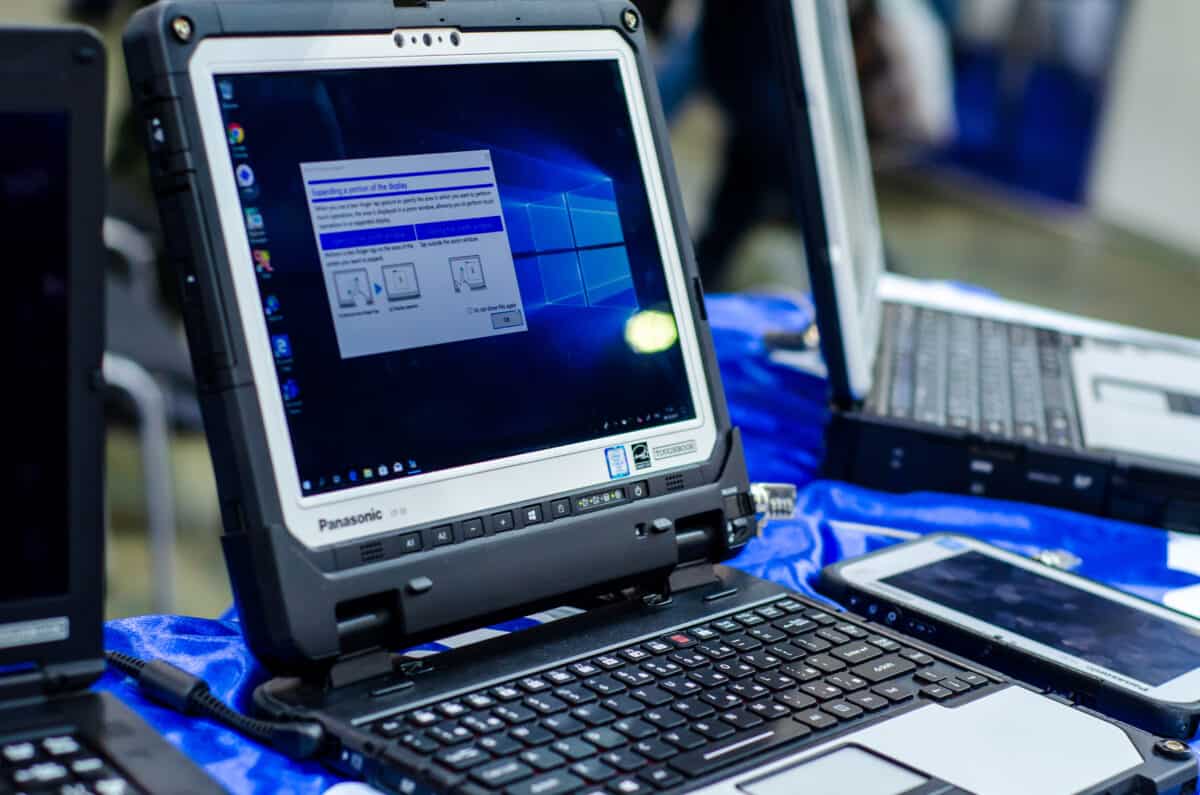
For professionals searching for tuff books, the phonetic spelling captures a category that has defined rugged computing for nearly three decades. The proper trademark is Panasonic Toughbook, and the line has held dominant market share in rugged laptops since the mid-1990s. For fleet managers, IT directors, and field professionals weighing a rugged hardware investment, understanding what separates a Toughbook from a hardened consumer laptop is the starting point. This guide outlines the engineering hallmarks, the current lineup, and the use cases that have made the platform the standard reference in its category.
A Brief History of the Toughbook
Panasonic introduced the Toughbook line in 1996, initially targeting field service technicians and telecommunications crews who needed laptops that could survive drops, vibration, dust, and temperature extremes. Over the following decade the line expanded into military, public safety, utilities, oil and gas, healthcare, and manufacturing. Today the Toughbook portfolio spans semi-rugged and fully rugged laptops, detachable 2-in-1 designs, and rugged tablets, all engineered, manufactured, and tested under Panasonic’s own roof.
What Makes a Toughbook a Toughbook
Several engineering decisions separate a Toughbook from a hardened consumer laptop:
- Certified durability. Current Toughbook models are certified to MIL-STD-810H, the U.S. military standard for drops, shock, vibration, temperature extremes, humidity, dust, and altitude. Ingress protection ranges from IP53 on semi-rugged models to IP66 on the fully rugged flagship.
- Vertical integration. Panasonic engineers, builds, and tests its own products in-house, an uncommon practice in computing. The result is consistent quality control and guaranteed parts availability for five years after end-of-life.
- Modular construction. Newer models use xPAK expansion slots that let IT teams add or swap components such as serial ports, barcode readers, smart card readers, and secondary batteries without specialized service.
- Field-serviceable design. User-replaceable batteries, drives, RAM, and keyboards reduce mean time to repair and extend useful life across a fleet.
- Documented reliability. Panasonic’s published data indicates Toughbook devices are roughly five times more reliable than general business laptops, lowering failure rates across multi-year deployments.
The Current Toughbook Lineup at a Glance
The 2026 lineup covers several form factors:
- Toughbook 40 (FZ-40). The fully rugged flagship 14-inch laptop, IP66 certified and rated for 180-centimeter drops, designed for environments where downtime is unacceptable. A refreshed FZ-40E with the latest Intel Core Ultra processors entered the market in spring 2026.
- Toughbook 55 (FZ-55). The semi-rugged 14-inch workhorse, lighter than the FZ-40 and built around the xPAK modular expansion system. Currently in its third generation.
- Toughbook 56 (FZ-56). A new 14-inch model launching summer 2026, positioned between the FZ-55 and FZ-40. Notable for a 16:10 display, a discrete GPU option for AI workloads, and 10-gigabit ethernet, a rugged industry first.
- Toughbook G2 (FZ-G2). A fully rugged 10.1-inch 2-in-1 with detachable keyboard, IP65 rated, weighing 2.9 pounds as a tablet.
- Toughbook 33 (CF-33). A fully rugged 12-inch 2-in-1, IP65 rated, with a detachable display for hybrid laptop-and-tablet use.
Where Toughbooks Are Deployed
Toughbooks serve in environments where a single device failure has operational consequences:
- Public safety. Patrol vehicles, fire and EMS apparatus, and field command posts.
- Military and government. Forward operations, command vehicles, and depot maintenance.
- Utilities and telecommunications. Line crews, substation work, and pole-top maintenance.
- Oil, gas, and mining. Drilling sites, refineries, and remote inspection.
- Construction and manufacturing. Job sites, plant floors, and field engineering.
- Healthcare and field service. Mobile imaging, home health, and equipment maintenance.
The Total Cost of Ownership Case
The purchase price of a Toughbook is higher than a consumer laptop, but the math changes across a multi-year fleet deployment. Lower failure rates reduce service tickets and replacement cycles. User-replaceable components extend useful life. Backward-compatible docks protect previous investments in mounting hardware. Five-year guaranteed parts availability allows organizations to keep equipment in service well beyond what consumer-grade hardware supports. For fleets of any meaningful size, the lifetime cost per productive hour typically falls below the consumer-grade alternative.
Where to Source Panasonic Toughbooks
For organizations and individual buyers ready to specify a Toughbook, working with a specialist reseller that understands the lineup, configuration options, and refurbishment standards makes the difference between a good purchase and an excellent one. Tough Rugged Laptops stocks new and certified refurbished Panasonic Toughbook models across current and recent generations, with configuration guidance and warranty support tailored to fleet and individual deployments. Browse the inventory today to find the model and specification that match the environment you work in.
