



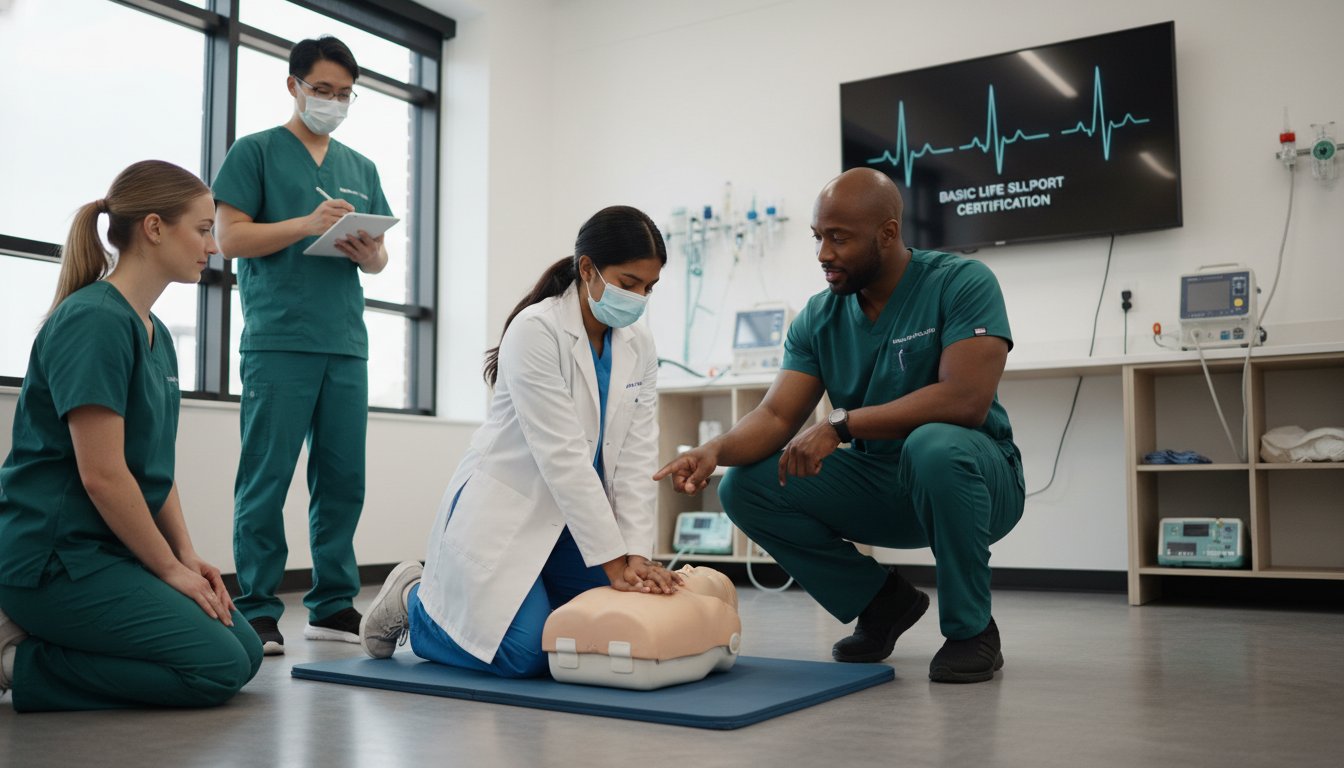
For Canadian healthcare workers, Basic Life Support certification is rarely optional. It is a baseline requirement for nurses, paramedics, respiratory therapists, dental professionals, medical students, and a growing list of allied health roles across provinces. What has changed in recent years is how that credential can be earned. Where in-person classroom training was once the only path, healthcare workers across Canada now have legitimate online options that meet employer and licensing requirements while removing the scheduling barriers that come with shift work, rural locations, and demanding caseloads. For professionals weighing the shift, bls certification online canada has become a practical and increasingly common route to maintaining required credentials without sacrificing clinical hours or personal time.
What BLS Actually Covers and Why It Matters
Basic Life Support is the foundation of emergency cardiac and respiratory care. The curriculum goes meaningfully deeper than general public CPR, reflecting the reality that healthcare workers respond to cardiac arrest in clinical environments where teams, equipment, and protocols are involved.
A current BLS course covers high-quality CPR for adults, children, and infants, the use of bag-mask devices and barrier protection, automated external defibrillator operation, recognition and management of cardiac arrest in clinical settings, choking response across age groups, and effective team-based resuscitation dynamics. The team component is particularly important. Real cardiac arrests in hospitals and clinics are rarely solo efforts, and BLS training teaches healthcare workers how to communicate, switch roles, and maintain compression quality during prolonged events.
Why Canadian Healthcare Employers Require It
Provincial regulatory colleges, hospital networks, long-term care facilities, and dental practices across Canada list BLS as a condition of employment or registration. Requirements vary slightly by province and employer, but most demand certification that aligns with the Heart and Stroke Foundation of Canada or the American Heart Association guidelines, both of which follow the same underlying International Liaison Committee on Resuscitation science.
Renewal cycles are typically every twelve months for high-acuity roles such as critical care nursing and every two years for most other healthcare positions. Letting certification lapse can mean removal from the schedule, loss of clinical privileges, or in some cases, professional discipline.
The Online Option: What Has Actually Changed
For years, online BLS training carried a reputation for being a lesser alternative. That perception is outdated. Modern online and blended programs use video-based instruction, interactive case scenarios, and verified knowledge assessments to deliver the cognitive portion of training, while skills verification can be completed through arranged in-person sessions or, for some roles and jurisdictions, through verified self-assessment with licensed instructor oversight.
The advantages for working healthcare professionals are concrete. Courses can be completed during off-shifts, broken into segments rather than requiring a full eight-hour day, and accessed from rural or remote locations where in-person classes are difficult to arrange. Renewal becomes far less disruptive to a working schedule, which means professionals are more likely to maintain continuous certification rather than letting it lapse.
What to Verify Before Enrolling
Not every online program meets Canadian employer standards. Before paying for a course, healthcare professionals should confirm several specifics.
First, verify guideline alignment. The course should explicitly follow current Heart and Stroke Foundation of Canada or American Heart Association BLS guidelines, both of which are accepted by the vast majority of Canadian healthcare employers.
Second, confirm credential format. A legitimate certification will issue a verifiable card or digital certificate with a unique identification number, a clear issue and expiration date, and the name of the issuing authority. Hospitals and licensing bodies regularly verify these credentials.
Third, check employer acceptance. Many regulatory colleges and hospital systems publish lists of accepted BLS providers. Cross-reference the program against your specific employer’s requirements before enrolling, particularly if you work in a high-acuity setting or are pursuing initial registration.
Fourth, consider the skills component. Some Canadian employers, particularly hospitals and acute care facilities, require hands-on skills verification regardless of how the cognitive portion was completed. A reputable online provider will be transparent about whether their certification includes a practical component or whether one must be arranged separately.
Maintaining Currency Beyond the Card
Holding a current BLS card is the minimum standard. Maintaining genuine readiness is something more. Healthcare professionals who participate in periodic mock codes, review updated resuscitation science between renewals, and stay familiar with the specific equipment used in their work environment perform measurably better during actual emergencies.
The 2025 ILCOR science updates introduced refinements to compression depth recommendations, post-arrest care, and team communication standards. Quality programs incorporate these updates into their current curriculum, which is another reason to choose a provider that updates content rather than recycling material from older guideline cycles.
Choosing a Provider That Fits Your Practice
The right program depends on the specifics of your role, your employer’s requirements, and your schedule. Healthcare workers in remote provinces or territories often find online options indispensable, while those in major metropolitan hospitals may have access to in-house training that meets their needs. For most Canadian healthcare professionals, a hybrid approach, online cognitive training paired with in-person skills verification when required, offers the best balance of flexibility and rigor.
Simple CPR provides online BLS certification programs that follow current AHA-aligned guidelines and issue credentials with verifiable identification, making them a practical option for Canadian healthcare workers who need to maintain certification without disrupting clinical schedules. Whatever provider you choose, the goal remains the same: walking into your next shift confident that if a code is called, you are ready to be part of the team that brings someone back.
