



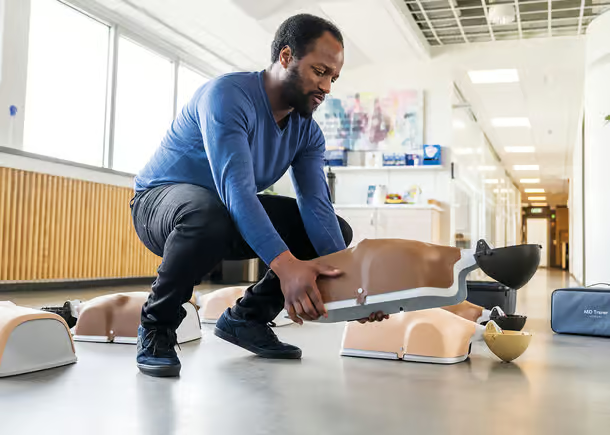
When a person collapses from sudden cardiac arrest, the difference between life and death often comes down to what happens in the first ten minutes, long before paramedics arrive. The right CPR tool, in the hands of a trained or even partly trained bystander, can meaningfully improve the odds of survival. For healthcare professionals, childcare workers, fitness trainers, and members of the general public who may one day be the closest responder, understanding what tools exist and how they support effective CPR is a core part of being ready.
Why CPR Tools Matter
High-quality chest compressions are surprisingly difficult to deliver without help. Current American Heart Association guidelines call for a compression rate of 100 to 120 per minute, a depth of at least two inches in adults, full chest recoil between compressions, and minimal interruption. Studies have repeatedly shown that even trained rescuers tend to compress too slowly, too shallowly, or too fast under stress. CPR tools exist to close that gap. They provide rhythm, depth feedback, instructions, or barrier protection so that the rescuer can focus on the patient rather than on remembering every step.
The Major Categories
Automated external defibrillators. The AED is the most widely recognized CPR tool. It analyzes the heart’s rhythm and delivers a shock if needed, dramatically increasing survival rates when used within the first few minutes of arrest. Modern public access AEDs are designed to walk an untrained user through the entire process with clear voice prompts. They are now standard in airports, schools, gyms, office buildings, and many other public spaces.
Audio-guided CPR coaching devices. A smaller but increasingly important category, these are pocket or wall-mounted devices that, with the press of a button, talk a rescuer through every step of CPR in plain language. They are designed for the person who has never been formally trained, or who completed a course years ago and cannot remember the details under pressure. The instructions cover everything from calling emergency services to setting and maintaining compression rhythm.
Real-time feedback devices. Used in both training and clinical settings, these tools rely on accelerometers and pressure sensors to measure compression depth, rate, and recoil in real time, then provide audio or visual prompts to correct the rescuer. They are common in hospital crash carts and in high-end training programs because they consistently improve compression quality.
Apps and digital aids. Smartphone applications can serve as metronomes set to 100 to 120 beats per minute, walk users through the steps of CPR, or locate the nearest AED through public registries. Most are free, immediately available, and useful as both training reinforcement and emergency reference.
Barrier devices and pocket masks. Pocket masks with one-way valves allow rescue breathing without direct mouth-to-mouth contact. Face shields offer a lighter, more portable option for the same purpose. These tools address the practical and hygienic concerns that sometimes cause bystanders to hesitate at the critical moment.
What Tools Cannot Replace
It is worth being honest about the limits. No tool can substitute for trained hands. Devices help most in the hands of someone who has practiced the underlying skill. A bystander who has completed even a basic certification course will respond faster, with more confidence, and with better outcomes than someone relying on a device alone. The tool amplifies preparation; it does not create it.
That is the case for keeping CPR training current. Guidelines update, techniques evolve, and the muscle memory of compressions fades without practice. Healthcare professionals typically recertify every two years, and childcare workers, fitness trainers, and teachers often have similar requirements. For the general public, where no formal requirement exists, the principle is the same: refresh the skill regularly, because cardiac arrest does not announce itself in advance.
Where to Train and Get Certified
For anyone in a role where CPR may one day be needed, whether at work, at home, or in the community, accessible training is the single highest-value investment in being ready. Simple CPR offers nationally recognized online CPR, BLS, and First Aid certification courses designed for working professionals and concerned individuals alike. Enroll today to make sure that when the moment comes, you have both the tools and the training to act.
