



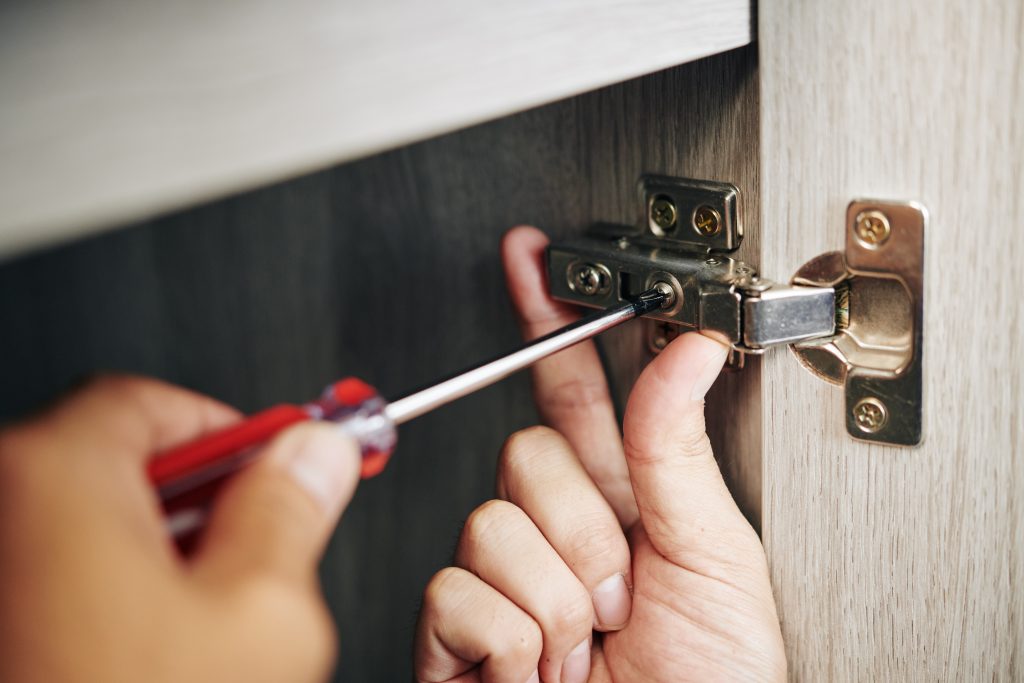
In many cases, the hinges are the first place to look. Modern Concealed hinges are designed to provide several adjustment points, making it possible to correct the position of a cabinet door without replacing the entire door or cabinet.
Contents
ToggleWhy Won’t My Cabinet Door Close?
There are several reasons a cabinet door may stop closing correctly. The most common include loose hinge screws, incorrect hinge alignment, a door that has shifted or sagged, damaged hinge hardware, or an obstruction inside the cabinet.
Humidity can also affect wooden cabinet doors and cause swelling or warping. In other situations, the cabinet itself may have shifted slightly out of square, making it difficult for the door to line up with the opening.
Before replacing the door or hinges, it is worth identifying exactly where the problem occurs.
Start by Watching the Door Close
Open the cabinet door and slowly close it while paying attention to where it stops.
If the door rubs against one side of the cabinet, the hinges may need a side-to-side adjustment. If the top or bottom edge catches, the door may have sagged. If the door reaches the cabinet but remains slightly proud instead of sitting flush, a depth adjustment may be necessary.
This simple observation can prevent unnecessary adjustments and help you determine which part of the hinge needs attention.
Check for Loose Hinge Screws
Loose screws are one of the easiest problems to overlook. Repeated opening and closing can gradually loosen hinge screws, allowing the door to move out of its original position.
Open the door and inspect each hinge carefully. Check both the screws securing the hinge to the door and those attaching the mounting plate to the cabinet.
Tighten loose screws gently with an appropriate screwdriver. Avoid excessive force because overtightening can damage the cabinet material or strip the screw hole.
If a screw turns continuously without becoming tight, the problem may be a stripped mounting hole rather than a loose screw.
Understand How Concealed Hinges Work
Many contemporary cabinets use European-style concealed hinges. When the door is closed, these hinges are hidden, but they can usually be seen once the door is opened.
One major advantage of Concealed hinges is their adjustability. Depending on the hinge design, adjustments can move the door:
- Side to side
- Up and down
- In and out
These movements allow you to correct uneven gaps, sagging, rubbing and doors that do not sit flush with the cabinet.
The exact position of adjustment screws varies between hinge designs, so it is important not to assume that every hinge uses the same screw arrangement.
Adjust the Door Side to Side
If the gap between the cabinet door and its neighbour is uneven, the side-to-side adjustment may be the solution.
A small adjustment can move the door left or right and help create a more consistent reveal around the cabinet opening. This is particularly useful when two adjacent doors overlap or when one edge is touching the neighbouring door.
Make a small adjustment and close the door to check the result. It is much easier to make several small corrections than to make one large adjustment and then try to correct an overshoot.
Correct the Door Height
A cabinet door that appears lower or higher than surrounding doors may need a height adjustment.
Depending on the hinge design, this may involve loosening the mounting screws slightly and repositioning the hinge or using a dedicated adjustment mechanism.
Support a heavy door while making this adjustment. Once the door is correctly positioned, tighten the mounting screws securely without forcing them.
A properly aligned door should have an even relationship with the cabinet opening and neighbouring doors.
Use Depth Adjustment When the Door Sits Proud
Sometimes a cabinet door appears correctly aligned from side to side but still will not close completely. It may sit slightly farther forward than it should or rub against the cabinet frame.
This is where the depth adjustment on many concealed hinges becomes important.
Depth adjustment moves the door inward or outward relative to the cabinet. A small change can allow the door to sit flush and clear the cabinet frame when closing.
Adjust gradually and test the door after each change. Different hinge manufacturers use different mechanisms, so the correct screw should be identified before making an adjustment.
Check the Soft-Close Mechanism
Soft-close cabinets contain a damping mechanism designed to slow the door before it reaches the closed position.
If the door suddenly becomes difficult to close, inspect the hinge for a damaged or obstructed soft-close mechanism. Some hinges also have a small switch or adjustment feature associated with the damping function.
If the hinge itself has become damaged, adjustment may not solve the problem. A mechanically worn or broken hinge may need replacement rather than further adjustment.
Look for Obstructions Inside the Cabinet
Not every cabinet-closing problem is caused by the hinge.
Check whether something inside the cabinet is preventing the door from closing. Shelves, stored containers, drawer fronts, or objects that have shifted forward can interfere with the door.
Also inspect the cabinet edge for anything that may have become loose or swollen. A small obstruction can create the impression that the hinge is malfunctioning.
What If the Hinge Screws Are Stripped?
A stripped screw hole can make hinge adjustment ineffective. The hinge may appear properly adjusted, but it can move again because the mounting screw cannot grip the cabinet material securely.
This problem is particularly relevant to cabinets made from materials such as particleboard or MDF.
Instead of repeatedly tightening the same screw, the damaged hole should be properly repaired or the appropriate replacement hardware installed. If the mounting area is badly damaged, professional cabinet repair may be preferable.
Check for a Warped or Swollen Door
If the hinges appear secure and properly adjusted but the door still will not close, inspect the door itself.
Wood can respond to changes in moisture and humidity. A swollen or warped panel may no longer fit the cabinet opening correctly. Water exposure around sinks and other damp areas can make this problem more noticeable.
A severely warped door generally cannot be corrected simply by turning hinge screws. Excessive adjustment may actually place unnecessary stress on the hinge.
Check Whether the Cabinet Is Square
Another possibility is that the cabinet box itself is no longer properly aligned.
If several doors in the same cabinet are experiencing similar problems, the issue may not be an individual hinge. The cabinet could have shifted, settled, or become slightly out of square.
Look at the cabinet structure as well as the door. If the cabinet opening is visibly uneven, repeatedly adjusting individual hinges may only provide a temporary solution.
A Simple Hinge-Adjustment Routine
When troubleshooting a cabinet door, use a systematic approach:
- Open the door and inspect every hinge.
- Tighten any loose screws carefully.
- Check for stripped screw holes.
- Look for objects blocking the door.
- Identify whether the door is too high, low, far forward, far back, or shifted sideways.
- Make one small hinge adjustment.
- Close the door and inspect the alignment.
- Repeat gradually until the door closes smoothly.
Most modern concealed hinges are designed specifically to allow this type of fine adjustment.
When Should You Replace the Hinge?
Adjustment is useful when the hinge is mechanically sound. It cannot repair a hinge that is cracked, bent, severely worn, or unable to hold its position.
Consider replacement when the hinge repeatedly loses its adjustment, the hinge body is damaged, the mounting plate will not remain secure, or the door still refuses to align after reasonable adjustments.
Replacing a damaged hinge with the correct type can restore proper operation, but the replacement should match important characteristics such as mounting style, overlay, opening angle, cup configuration, and door construction.
Final Thoughts
A cabinet door that will not close is often a small alignment problem rather than a reason to replace the entire cabinet. Start with the hinges, check for loose screws and obstructions, and then determine whether the door needs a side-to-side, height, or depth adjustment.
For cabinets equipped with Concealed hinges, the built-in adjustment system can make these corrections considerably easier. Work slowly, make small changes, and test the door after every adjustment. If the hinge or cabinet material is damaged, however, replacement or professional repair may be the better long-term solution.
